Use a table near a window
Lay one page flat. Bright indirect daylight usually works better than a ceiling light or phone flash, especially on glossy sleeves. Move the page until your phone and hands stop casting a shadow.
Phone-photo guide
You do not need a scanner or a light box. A useful photo shows the whole page, keeps the smallest writing sharp and preserves whatever is on the back.
Lay one page flat. Bright indirect daylight usually works better than a ceiling light or phone flash, especially on glossy sleeves. Move the page until your phone and hands stop casting a shadow.
Keep the camera parallel to the page rather than shooting from the side. Let the card fill most of the frame, but leave a narrow border around all four edges so no ingredient or margin note is lost.
Open the photo and inspect the faintest pencil and smallest fraction. If the writing looks soft when enlarged, tap the writing to focus and take it again. A neat stack of blurry photos is still a blurry stack.
Photograph the back whenever it holds a name, variation, date, second recipe or stray instruction. Keep both images together. Recipe Box Press joins related pages during sorting; the order you photograph them does not have to be perfect.
Include the evidence
Do not clean up the page in an editing app or crop around a hard-to-read amount. Those marks can explain which version the family used. If we cannot settle a quantity from the submitted pages, we show the exact line and ask what the book should say.
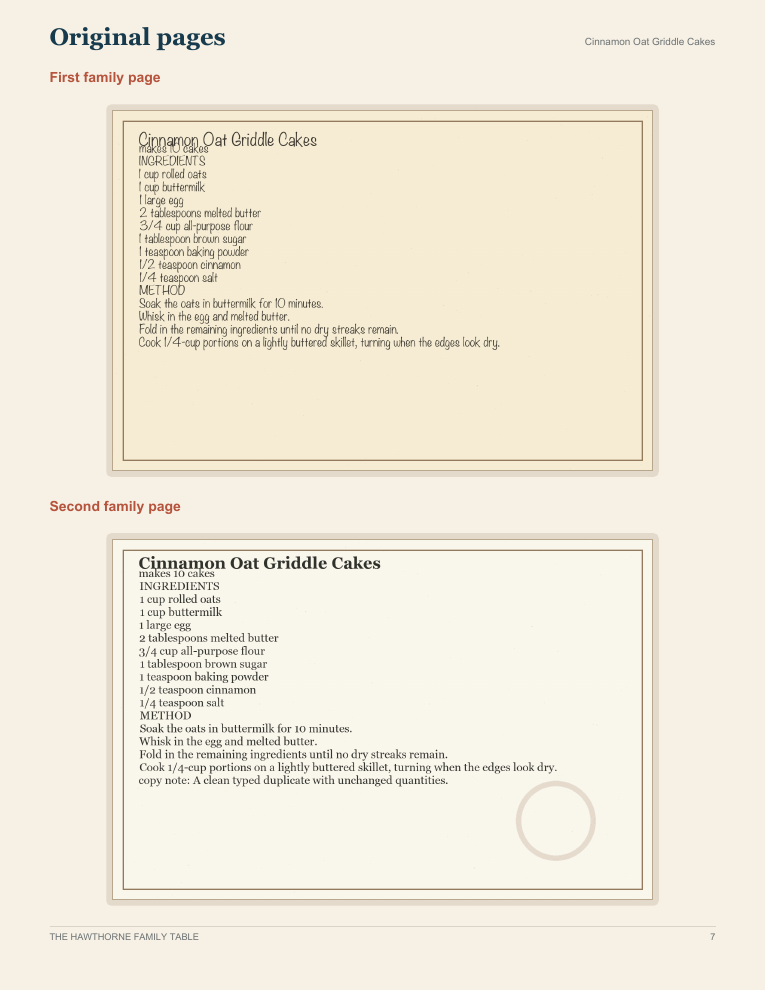
The page shown here is fictional material made for the Recipe Box Press demonstration.
Before you put the card away
The Recipe Box Press planner lets you try a cover photograph, dedication, family note, type style and section order without uploading anything.
Make a cookbook planOpen the 11-page sample